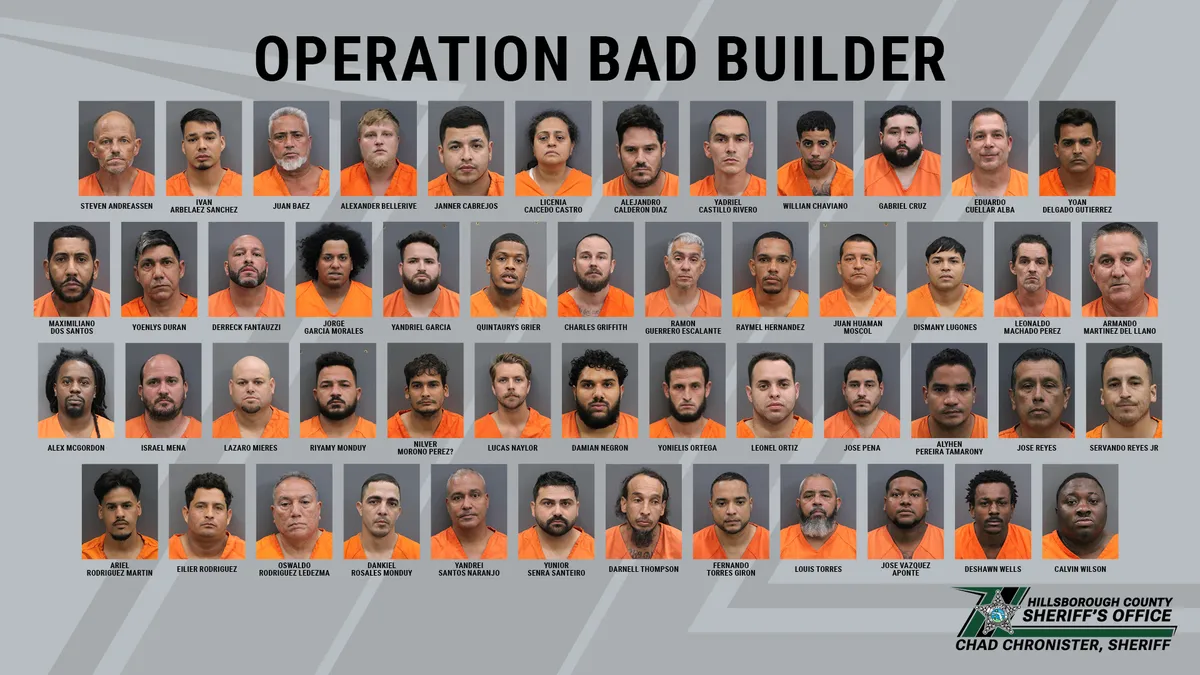
50 Unlicensed Contractors Arrested in Florida: Why Contractor Licensing Matters
Fifty people were arrested in Hillsborough County, Florida, for allegedly performing construction work without the proper contractor licenses. The arrests were part of an undercover investigation called Operation Bad Builder, conducted by the Hillsborough County Sheriff's Office.
As a licensed Florida General Contractor, this is something I take seriously because I've personally seen what happens when homeowners hire people who aren't properly licensed.
Sometimes the work gets done incorrectly. Sometimes contractors collect deposits and disappear. And sometimes homeowners end up spending more money fixing the original work than they would have spent hiring a licensed contractor in the first place.
Unfortunately, unlicensed contracting is a much bigger problem in Florida than many people realize.
What Happened During Operation Bad Builder?
According to FOX 13 Tampa Bay, the Hillsborough County Sheriff's Office conducted an undercover investigation between June 1 and October 2, 2026.
Detectives set up a location in Riverview, Florida, where they posed as homeowners looking for construction services. They contacted individuals advertising construction work online and invited them to provide estimates for different projects.
Some of these individuals had already received complaints from homeowners for poor workmanship, unfinished projects, or taking money without completing the promised work.
By the end of the operation, 50 individuals had been arrested for alleged unlicensed contracting activity.
That's 50 people in approximately four months, in just one Florida county.
And this isn't something happening only in Tampa. Unlicensed contracting is a problem throughout Florida, including Orlando, Jacksonville, Miami, and other areas experiencing substantial construction activity.
With the number of people moving to Florida, new homes being built, renovations taking place, and homeowners repairing hurricane damage, there is tremendous demand for construction services.
Unfortunately, some individuals take advantage of that demand by offering construction services without obtaining the licenses required by Florida law.
A Florida Contractor License Is More Than Just a Piece of Paper
One of the biggest misconceptions about contractor licensing is that it's simply a government requirement or a piece of paper allowing someone to operate a construction business.
That's not what it is.
A contractor license demonstrates that an individual has met specific requirements involving construction knowledge, experience, examinations, and financial responsibility.
For example, to become a Florida Certified General Contractor, applicants generally must pass three examinations:
Business and Finance
Contract Administration
Project Management
These are open-book examinations, but they're not easy. You need to understand construction contracts, business operations, project management, safety requirements, building codes, and how to navigate the reference books.
After passing the examinations, applicants must submit an application to the Florida Department of Business and Professional Regulation (DBPR), documenting their qualifying construction experience and satisfying the remaining licensing requirements.
I've personally gone through this process, and I can tell you there's a reason Florida requires contractors to demonstrate their knowledge and experience.
Does having a contractor license automatically mean someone is a perfect contractor? Of course not.
But it establishes minimum qualifications and provides a system of accountability.
When someone is working on your home, especially when the work involves structural components, electrical systems, plumbing, roofing, or air conditioning, that matters.
I've Seen What Happens When Homeowners Hire Unlicensed Contractors
Before starting Florida Exam Prep, I worked in construction and eventually managed crews and subcontractors on different projects.
There were plenty of situations where a homeowner would call me for an estimate, I'd look at the project, calculate the costs, and provide a proposal.
Then they'd tell me another contractor could do the job for significantly less.
And sometimes that other person didn't have a contractor license.
I understand why homeowners want to save money. Construction is expensive, and when someone offers to do the same job for thousands of dollars less, it sounds attractive.
But there's a reason licensed contractors sometimes cost more.
We have insurance expenses, licensing requirements, business overhead, and responsibilities involving permits, inspections, and managing projects properly.
Someone working without a license may avoid many of those expenses.
I've had situations where a homeowner chose the cheaper option, only to contact me a month or two later because the work wasn't completed correctly.
Now they need someone to come back, inspect the problems, and figure out how to fix everything.
And fixing someone else's mistakes isn't always cheap.
Sometimes you have to remove work that was already completed just to correct what's underneath.
That's why I always tell homeowners that hiring the cheapest contractor can sometimes become the most expensive decision you make.
How to Verify a Contractor License in Florida
One of the easiest ways to protect yourself is to verify a contractor's license before signing a contract or paying a deposit.
Florida makes this relatively simple.
Visit www.MyFloridaLicense.com and use the license verification system.
You can search for a contractor using their name, company name, or license number.
The database allows you to review information such as their license classification, license number, and current status.
For example, if you're hiring someone to perform air conditioning work, you should verify that they're properly licensed for the HVAC work they're offering.
The same applies to electrical, plumbing, roofing, and other regulated construction trades.
And here's something important that many homeowners don't understand:
Just because someone has an LLC or a registered construction business does not mean they're a licensed contractor.
Registering a business with the Florida Division of Corporations is completely different from obtaining a contractor license through DBPR.
I've had homeowners contact me after experiencing problems with contractors, and one of the first things I ask is for the contractor's license number.
Sometimes all they have is the person's name or a company name.
When I look them up, I can't find an active contractor license that authorizes the work.
That's a major red flag, and it's something homeowners should check before hiring anyone.
Contractor Advertisements, Websites, and Trucks Should Display License Information
Another important requirement involves how contractors advertise their services.
Under Florida Statute 489.119, construction contractors subject to the statute must include their license or registration numbers in specified advertisements and business materials.
This includes advertisements for contracting services, and Florida also has requirements involving license numbers on commercial vehicles used by contractors.
If someone is advertising roofing, electrical, plumbing, air conditioning, or general contracting services, I recommend checking for their license number.
That includes advertisements on Facebook, Google, websites, and other marketing platforms.
If I see someone advertising contracting services without a license number, that's immediately a red flag to me.
It doesn't automatically mean the person is unlicensed, but it gives me a reason to investigate.
The same goes for company vehicles.
If a contractor arrives at your property in a company truck, look for their license information and verify it through DBPR.
And don't assume that having a professional website, nice business cards, or an expensive truck means someone is legally authorized to perform construction work.
Always verify the license.
Can a General Contractor Perform Electrical, Plumbing, or HVAC Work?
This is something a lot of homeowners and even some contractors misunderstand.
A Florida Certified General Contractor can manage construction projects involving multiple trades, but that doesn't automatically authorize them to personally perform every specialized trade.
For example, let's say a homeowner hires me to completely renovate their kitchen.
The project includes removing cabinets, installing new finishes, moving plumbing lines, relocating electrical outlets, and installing new lighting.
As a General Contractor, I can take responsibility for coordinating the overall project within the scope of my license.
However, when the project requires regulated electrical or plumbing work, I need to make sure it's performed by the properly licensed trade contractor or otherwise authorized personnel under Florida law.
If we're moving electrical outlets, that work generally needs to be handled by an appropriately licensed electrical contractor.
If we're relocating plumbing lines, that generally requires a properly licensed plumbing contractor.
The same applies to regulated air conditioning work.
A General Contractor license does not automatically replace an electrical, plumbing, or HVAC contractor license.
This is why understanding the scope of your contractor license is extremely important.
What Are the Penalties for Unlicensed Contracting in Florida?
Some people perform construction work without a license because they think the worst that can happen is receiving a fine.
Unfortunately, the consequences can be much more serious.
Under Florida Statute 489.127, performing work that requires a contractor license without being properly licensed can result in criminal penalties.
For certain violations, the penalties generally include:
First offense — First-Degree Misdemeanor
A first-degree misdemeanor can carry up to one year in jail and a fine of up to $1,000.
Subsequent qualifying offense — Third-Degree Felony
A qualifying repeat violation after a prior finding of guilt can result in a third-degree felony, potentially punishable by up to five years in prison and a fine of up to $5,000.
Unlicensed contracting during a declared state of emergency
Certain unlicensed contracting violations committed during a qualifying declared state of emergency may also constitute a third-degree felony.
Actual charges and penalties depend on the specific circumstances and applicable law.
Think about that.
Someone might perform construction work without a license because they don't want to spend the time studying for the examinations or going through the application process.
But the consequences can potentially include a criminal conviction, jail time, and serious damage to their future ability to operate a legitimate business.
In my opinion, that's not worth the risk.
Why Building Permits and Inspections Are So Important
One of the biggest concerns I have with unlicensed contracting is the possibility of work being completed without required permits or inspections.
As a licensed General Contractor, when I'm working on a project that requires permits, I want those permits pulled and the required inspections performed.
Why?
Because it protects both me and the homeowner.
The contractor is responsible for performing and overseeing the work within their scope, and the local building department provides additional oversight through the applicable inspection process.
That helps identify work that doesn't comply with the building code.
Here's an example.
Imagine someone renovates a kitchen and installs beautiful cabinets, expensive countertops, and new flooring.
Everything looks great when you walk into the room.
But behind the walls, the electrical wiring was installed incorrectly, plumbing connections weren't properly completed, or structural modifications were made without the necessary approvals.
I like to call that putting lipstick on a pig.
The project looks good on the outside, but underneath, there could be serious problems.
And sometimes those problems don't become obvious until months or years later.
That's why I always recommend that homeowners ask whether permits are required for the work being performed.
Not every construction project needs a permit, but when one is legally required, it should be obtained.
If a contractor immediately starts making excuses about why they don't want to pull permits, that's another warning sign.
Five Things Every Homeowner Should Check Before Hiring a Florida Contractor
If you're planning a construction project in Florida, here are five things I recommend doing before hiring anyone.
1. Verify the contractor's license. Visit MyFloridaLicense.com and confirm the contractor has an active license for the type of work being performed.
2. Ask for proof of insurance. Request proof of general liability insurance and workers' compensation coverage, or documentation of an applicable exemption. Make sure the coverage is appropriate for the project.
3. Get a written contract. The contract should clearly explain the scope of work, total price, payment schedule, and other important project terms.
4. Verify permits and inspections. Ask whether the project requires permits and confirm that the appropriate permits and inspections will be obtained and completed.
5. Be careful with upfront payments. Avoid paying the entire project amount before the work is completed, and make sure you understand the payment schedule before signing anything.
Taking these steps can help protect your home, your money, and your family.
Florida Needs More Licensed Contractors, Not More Unlicensed Activity
Here's something I want to make clear.
I understand that there are people working in construction who have years of experience but don't have a contractor license.
Some of these individuals might be excellent tradespeople. They may have spent 10, 15, or even 20 years working in construction.
But experience alone does not automatically authorize someone to operate as a contractor in a trade that requires a license.
Florida has a licensing process for a reason.
And if you already have substantial construction experience, you may be closer to qualifying for a contractor license than you realize.
Depending on the license classification, your education and documented construction experience may help you meet the requirements.
Instead of continuing to perform work that requires a license without having one, I strongly recommend looking into the licensing process.
For many contractors, the biggest obstacle isn't necessarily their construction experience.
It's passing the examinations and understanding how to prepare the application correctly.
That's exactly why I started Florida Exam Prep.
How to Get Your Florida Contractor License
If you're interested in becoming a licensed contractor in Florida, the process generally involves determining which license classification you qualify for, passing the required state examinations, documenting your qualifying experience, and submitting your application to DBPR.
For someone pursuing a Florida Certified General Contractor license through the standard examination route, the three examinations are Business and Finance, Contract Administration, and Project Management.
All three are open-book examinations, and with the correct study materials and preparation, they're absolutely manageable.
At Florida Exam Prep, we help students prepare through organized online courses, reference book highlighting, practice questions, exam simulators, and step-by-step instruction.
We also provide contractor license application assistance for students who need help documenting their experience and preparing their applications.
I've worked with contractors from many different backgrounds, including people who have spent years in construction but never knew where to start with getting licensed.
The important thing is to start the process correctly.
Final Thoughts
Fifty arrests in Hillsborough County should be a reminder of how seriously Florida treats unlicensed contracting.
And remember, this was one operation in one county.
As construction continues throughout Florida, homeowners need to be careful about who they hire, and contractors need to make sure they're operating within the law.
I fully support efforts to crack down on unlicensed contracting because they protect homeowners and the contractors who have invested the time and effort to become properly licensed.
If you're a homeowner, take five minutes to verify someone's license before handing over thousands of dollars.
If you're already a licensed contractor, make sure the subcontractors you hire are properly licensed for the work they're performing.
And if you're currently working in construction without the license required for the work you want to offer, start looking into how you can become licensed.
Getting your Florida contractor license is an investment in your future, your business, and your credibility.
If you need help preparing for your Florida contractor examinations or completing your license application, visit Florida Exam Prep.
We're here to help you take that next step.
Sources:
FOX 13 Tampa Bay: 50 Unlicensed Contractors Arrested During Operation Bad Builder
Florida Statute 489.127 — Prohibitions and Penalties
Florida Statute 489.119 — Business Organizations and License Number Requirements
Florida Department of Business and Professional Regulation — MyFloridaLicense.com