Why You're Getting 90% on Florida Contractor Practice Exams but Still Not Ready
Why You're Getting 90% on Florida Contractor Practice Exams but Still Not Ready
Florida Contractor Exam Tips | Business & Finance | Contract Administration | Project Management
One of the biggest problems I see with students preparing for the Florida contractor exam is how they use practice exams.
I'll have students tell me they're scoring 85%, 90%, sometimes even 100% on their practice tests, but when they take the real exam, they struggle.
And sometimes, when I ask them how they're studying, I immediately understand why.
They're looking up answers on Google or ChatGPT. They're skipping questions they don't understand. They're taking the same quizzes over and over until they memorize the answers. And when they finish, they look at their score and move on without reviewing anything.
You're not actually preparing for the exam when you do this. You're cheating yourself out of the practice you need.
I want to explain some of the most common mistakes I see students make with practice exams, and more importantly, what you should be doing instead.
1. Using ChatGPT or Google to Find Every Answer
I see this all the time.
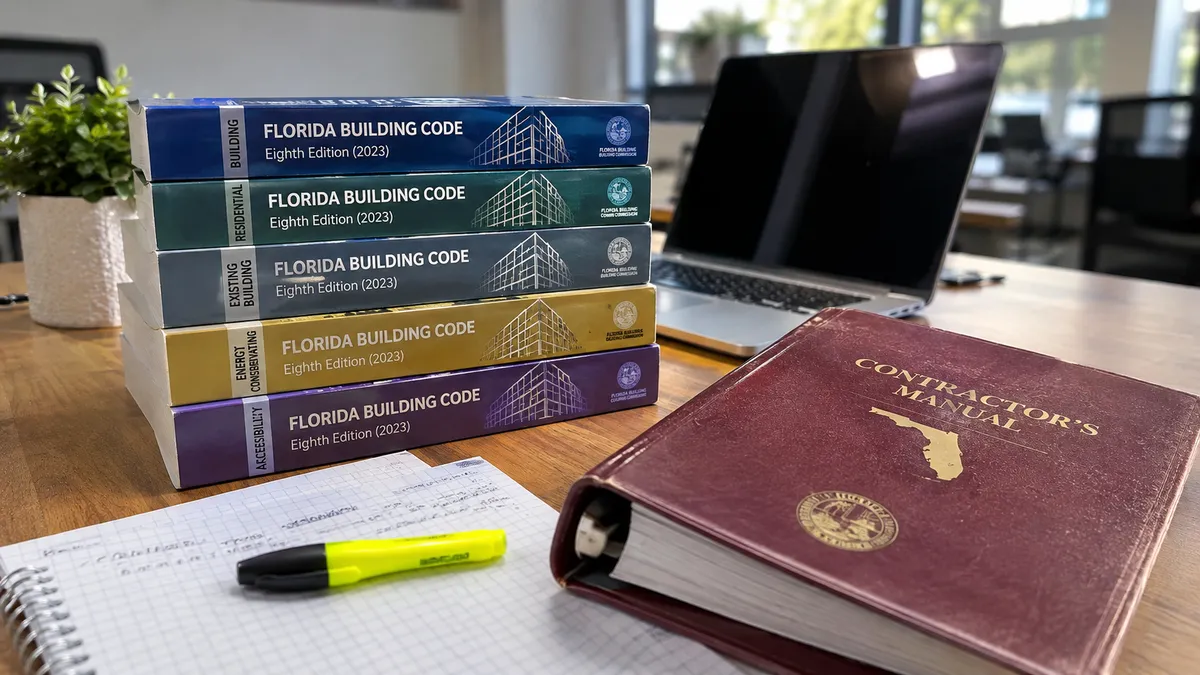
A student reads a practice question, doesn't immediately know the answer, and instead of opening their Contractor's Manual, OSHA book, or Florida Building Code, they type the question into ChatGPT.
Within seconds, they have an answer.
Great. You got the question right.
But what did you actually learn?
On the real Florida contractor exam, you won't have ChatGPT or Google available to find the answers for you.
You'll have your approved reference books and whatever knowledge you've developed while studying.
If you rely on AI every time you get stuck, you're skipping one of the most important parts of preparing for an open-book exam: learning how to search for information.
Don't get me wrong. AI can be a great tool for explaining difficult concepts, formulas, or subjects you don't understand.
But there's a difference between using AI to understand something and using AI to do your practice exam for you.
My advice is simple. Find the answer in your book first.
If you still don't understand why that's the correct answer, then use additional resources to help understand the explanation.
2. Not Finishing the Entire Practice Exam
Another mistake I see is students starting practice exams and never finishing them.
They answer 20 or 30 questions, get tired, lose focus, or become frustrated and stop.
Then they start another quiz the next day.
The problem is that you're never practicing the endurance required to complete the real exam.
For example, the Florida Business and Finance exam has 125 questions and a testing period of 6 hours and 30 minutes.
That's a long time to sit down, concentrate, navigate books, perform calculations, and make decisions.
The Contract Administration and Project Management exams also require you to maintain your focus while working through questions under a time limit.
If you only practice in short sessions, how are you going to know whether you can manage your time for the entire exam?
Now, there's nothing wrong with doing short, chapter-specific quizzes when you're learning a book.
But once you move into the final stages of preparation, you need to complete full-length practice exams under realistic conditions.
Don't quit just because the questions are getting difficult.
That's exactly when you need the practice.
3. Getting Questions Wrong and Never Reviewing Them
This is probably one of the most frustrating mistakes I see.
A student finishes a practice exam, gets a 65%, looks at the score, and immediately takes another one.
Or they get an 85%, feel good about themselves, and move on.
But they never go back to review the questions they got wrong.
Think about that for a second.
The practice exam just showed you exactly which questions you struggled with, and you're choosing to ignore that information.
Getting a question wrong isn't the problem. Not learning from it is.
Whenever you finish one of our quizzes or exam simulators at Florida Exam Prep, I want you to review the questions and explanations.
For every question you missed, ask yourself:
Which book was I supposed to use?
What chapter or section contained the answer?
What keywords in the question should have helped me find it?
Did I use the index or table of contents correctly?
Why did I choose the wrong answer?
How could I find this information faster next time?
Sometimes reviewing just five incorrect questions properly can teach you more than taking another 50-question quiz without reviewing anything.
4. Not Learning the Path to the Answer
This is something I emphasize constantly in my courses.
It's not enough to know where the answer is. You need to know how you got there.
Let me give you an example.
Suppose you're taking a Business and Finance practice exam, and a question asks about a Notice to Owner.
You eventually find the answer in the Contractor's Manual under Florida Construction Lien Law.
Good.
But now I want you to go back and think about how you found it.
Did you recognize that the question involved lien law?
Did you know which book to open?
Did you use the table of contents to find the correct chapter?
Did you search the index for "Notice to Owner"?
Or did you just flip through the book until you happened to find the correct information?
There's a huge difference.
When I say you should highlight your books, I don't mean just highlighting the answer.
I want you to learn and highlight the path that helped you locate it.
That might mean highlighting an important term in the index, marking the applicable chapter in the table of contents, and then highlighting the actual requirement inside the book.
That way, when you see a similar question on the real exam, you already know where to start looking.
You aren't starting from zero every time.
5. Memorizing Questions Instead of Learning the Books
A student takes a practice exam and gets a 60%.
They take it again and get a 75%.
Then an 85%.
Then a 95%.
That sounds like great progress, right?
Maybe.
But here's the question I always want to ask:
Are you finding the answers faster, or are you just remembering which answer was correct last time?
Those are two completely different things.
If you recognize a question and immediately remember that the answer is C, you haven't necessarily practiced using your books.
On the real exam, that same subject might appear with completely different wording.
They might change the numbers, include an exception, or ask the question from another angle.
That's why I encourage students to locate the answer in their reference book even when they already know the correct choice.
We use randomized question banks in our Florida Exam Prep quizzes and simulators to help students practice different questions.
But even with varying questions, it's important to avoid relying on memorization.
The goal isn't to become good at our practice exams.
The goal is to become good at taking the actual Florida contractor exam.
6. Not Using the Index and Table of Contents
One of the most underrated skills for any open-book contractor exam is knowing how to use the index and table of contents.
Some students skip these tools completely.
They open the book and start flipping through pages, hoping they'll recognize something familiar.
That might work occasionally, but it isn't an efficient strategy when you're working against the clock.
Let's say you get a Project Management question about scaffolding.
You should recognize that it's likely related to OSHA 29 CFR 1926.
From there, you can navigate to the applicable scaffolding requirements rather than searching randomly through hundreds of pages.
The same idea applies to Florida Building Code questions, AIA documents, and the Contractor's Manual.
Learn the keywords. Learn the terminology. Learn how each book is organized.
Sometimes a question won't use the exact same wording as the index, so you also need to understand the subject well enough to recognize related terms.
This takes practice.
And that practice happens when you're willing to spend time looking for an answer instead of immediately giving up.
7. Moving On Without Fixing Your Weak Areas
If you consistently miss questions about accounting, construction liens, OSHA safety regulations, or construction contracts, that should tell you something.
You have a weak area that needs attention.
But some students simply keep taking full practice exams and hoping their score improves.
I recommend something different.
If you're struggling with accounting, go back into the Builder's Guide to Accounting.
If you're missing questions about construction contracts, review the applicable AIA documents.
If you're struggling with safety questions, spend more time navigating OSHA.
Don't just keep repeating the same mistakes. Go back and fix them.
At Florida Exam Prep, we recommend mastering one reference book at a time before moving on.
Our goal is for students to consistently score at least 80% on their book-specific practice exams before progressing to the next stage.
But that score needs to reflect genuine understanding and navigation skills, not memorized answers.
How I Want My Students to Take Practice Exams
Here's the method I recommend to everyone preparing for their Florida General Contractor, Building Contractor, or Residential Contractor exams.
Step 1: Read the question carefully.
Don't rush. Identify what the question is asking and look for important keywords.
Step 2: Identify which book to open.
Before searching, think about which reference most likely contains the answer.
Step 3: Use the index or table of contents.
Find the appropriate chapter, section, or subject.
Step 4: Locate the answer yourself.
Read the applicable information carefully. Look for important exceptions, conditions, and wording that might change the answer.
Step 5: Highlight the information and navigation path.
Mark the relevant section and, when useful, the index or table-of-contents entry that helped you find it. Follow the exam's current rules for permitted markings and tabs.
Step 6: Finish the practice exam.
If you're doing a full-length simulator, complete it under timed conditions. If you get stuck, practice deciding when to move on and return to a difficult question.
Step 7: Review your results.
Go through every incorrect answer. I also recommend reviewing questions you guessed correctly because you may not understand them as well as your score suggests.
Step 8: Repeat until you can find answers confidently.
Your goal is to improve both accuracy and speed.
This process might feel slower in the beginning, but it's what makes you better at navigating the books.
I'd Rather See a Student Get 60% the Right Way Than 95% the Wrong Way
I mean that.
If you get a 60% on a practice exam but you genuinely tried to find every answer in your books, finished the exam, and went back to review your mistakes, that's useful progress.
Now we know what you need to work on.
But if you're getting a 95% because you searched the answers online, used AI, or memorized questions from previous attempts, that score doesn't tell me you're ready.
It only tells me you found a way to get a high score.
And that's not what we're preparing for.
I've had students tell me they're doing great on practice exams, but they struggle on the real test because they can't find answers quickly enough.
This is why I always ask students who are struggling whether they ran out of time, whether they understood the questions, and whether they were actually navigating the books during their preparation.
Those details matter far more than a practice score by itself.
How Florida Exam Prep Helps You Practice the Right Way
At Florida Exam Prep, we don't just give students a list of questions and tell them to memorize the answers.
Our courses are structured to help you understand the reference books and learn how to navigate them.
We provide video lessons, highlighting guidance, chapter quizzes, book-specific practice exams, and full-length exam simulators.
Our practice exams include explanations and references, so after completing a quiz, you can review the correct answers and learn where the information comes from.
And because our quizzes use question banks with randomized questions, you can practice repeatedly without relying solely on the same question sequence.
Whether you're preparing for the Florida Business and Finance exam, Contract Administration exam, or Project Management exam, the objective remains the same.
Learn how to find the answer.
If you're looking for additional practice, check out our Florida Contractor Exam Simulators.
Frequently Asked Questions About Florida Contractor Practice Exams
How many practice exams should I take before the Florida contractor exam?
There's no magic number. Focus on completing practice exams, reviewing incorrect answers, and improving your ability to locate information in the approved reference books. Consistent performance under timed conditions is more meaningful than the number of attempts alone.
Is scoring 80% on a Florida contractor practice exam good?
An 80% score can be a useful benchmark, and it's the minimum standard we recommend in our book mastery system. However, your score should come from finding answers independently, not memorizing questions or using outside tools.
Can I use ChatGPT to study for the Florida contractor exam?
Yes, AI can help explain difficult concepts and clarify terminology during your preparation. However, you shouldn't rely on AI to answer your practice questions because it prevents you from developing the book-navigation skills needed for the real exam. AI-generated answers can also be incorrect.
What should I do after failing a contractor practice exam?
Review the questions you missed. Find the correct answers in the reference books, identify the relevant chapters and keywords, and understand why your answers were incorrect. Then revisit the weak areas before taking another practice exam.
Why am I passing practice exams but failing the real contractor exam?
Possible reasons include memorizing practice questions, struggling with unfamiliar wording, poor time management, not knowing how to navigate the books, or practicing without realistic exam conditions. Review how you're studying rather than focusing only on your scores.
Final Advice: Stop Chasing Scores and Start Learning
If you're preparing for your Florida contractor license, I want you to remember one thing.
Your practice exam score doesn't matter nearly as much as what you learned while taking it.
Don't cheat yourself by looking up every answer.
Don't skip the difficult questions and never return to them.
Don't finish a quiz and ignore everything you got wrong.
And most importantly, don't forget to practice finding answers using the index, table of contents, and reference books.
Getting something wrong during a practice exam is an opportunity to learn something before the real exam.
Take advantage of it.
Spend the extra five or ten minutes finding the answer. Highlight the important section. Understand the path you used to get there.
Because when you're sitting at Pearson VUE taking your actual Florida contractor exam, those are the skills you're going to depend on.
Stop practicing just to get a passing score. Practice to become the person who knows how to find the answers.
— Cruz Vinci Greico