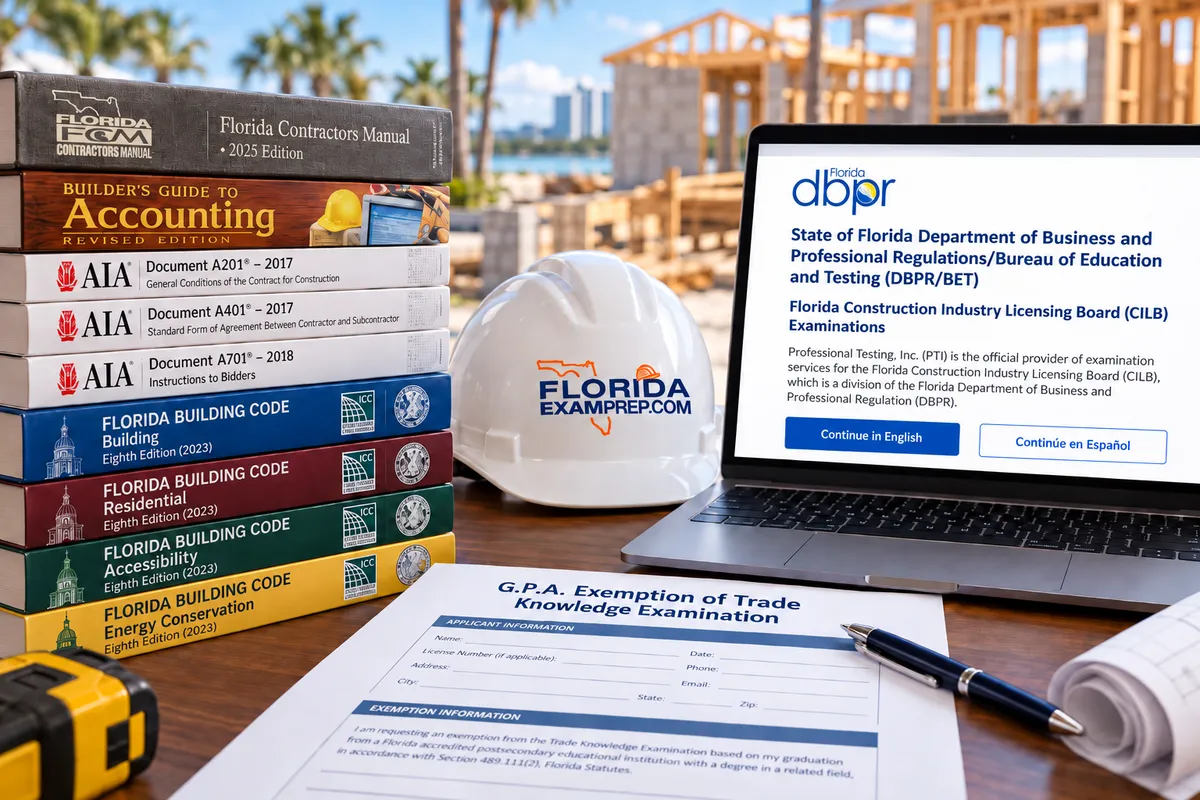
Florida Contractor Exam Exemption 3.0 GPA Guide
A lot of people don't realize that if you graduated from college with a construction-related bachelor's degree and a GPA of 3.0 or higher, you may qualify for an exemption from the Florida contractor trade knowledge exams.
This could save you months of studying, examination fees, and the stress of preparing for multiple contractor exams.
I've helped multiple applicants successfully obtain these exemptions through the Florida Department of Business and Professional Regulation (DBPR), and I want to explain exactly how the process works.
In this article, I'll cover which college degrees Florida recognizes for different contractor licenses, the difference between examination exemptions and licensing requirements, how to complete the paperwork, and what to do if your degree was earned outside the United States.
What Does Florida Law Say About the 3.0 GPA Exemption?
According to Florida Statute 489.113(1), applicants who received a bachelor's degree in building construction from an accredited four-year college, or a related degree approved by the Construction Industry Licensing Board by rule, with a GPA of 3.0 or higher are only required to pass the Business and Finance portion of the contractor examination.
This exemption became effective July 1, 2020.
For example, someone applying for a Florida General Contractor license would normally have to pass three exams: Business and Finance, Contract Administration, and Project Management.
If that applicant qualifies for the exemption, they can skip Contract Administration and Project Management. They only need to pass Business and Finance.
The exemption can also apply to eligible Division II applicants, including roofing, HVAC, mechanical, plumbing, and other construction license classifications.
It's important to understand that this only exempts you from the trade knowledge examinations. It does not automatically qualify you for a contractor license or eliminate the required construction experience.
Read Florida Statute 489.113(1)
Which College Degrees Are Appropriate for Each Florida Contractor License?
This is where I see a lot of confusion.
Not every college degree is treated the same way for every contractor license.
The 2025 Florida Contractors Manual, Chapter 2, page 2-10, includes a section titled Appropriate Baccalaureate Degree.
This section references Florida Administrative Code 61G4-15.001(4), which identifies the bachelor's degrees considered appropriate for various contractor license classifications under the education-and-experience eligibility pathway.
Here's the breakdown.
1. General Contractor, Building Contractor, and Residential Contractor
For these three classifications, the rule identifies the following appropriate degrees:
Civil Engineering
Building Construction
Architecture
These degrees are recognized under the rule because they relate to building design, construction methods, structural systems, materials, and construction processes.
Civil Engineering: This degree generally focuses on structures, foundations, construction materials, surveying, and engineering principles. Someone with a civil engineering degree may qualify for the applicable education-and-experience pathway for a General, Building, or Residential Contractor license.
Building Construction: This is directly related to the construction industry. Programs often cover estimating, construction management, scheduling, building materials, codes, and construction operations. It is also the degree specifically named in the 3.0 GPA examination exemption statute.
Architecture: Architecture degrees focus on building design, construction systems, building materials, plans, and related technical subjects. Architecture is listed as appropriate for these three classifications under the education-and-experience rule.
For example, if you earned a bachelor's degree in Civil Engineering with a GPA of 3.4 and want to become a Florida General Contractor, the rule specifically recognizes Civil Engineering for the degree-based licensing experience pathway. You should also ask DBPR to confirm that your degree is accepted for the separate GPA examination exemption before assuming you can skip Contract Administration and Project Management.
2. Class A and Class B Air Conditioning Contractors
For Florida Class A and Class B Air Conditioning Contractor licenses, the rule identifies:
Mechanical Engineering
Mechanical Engineering is directly related to HVAC systems, including heating and cooling equipment, thermodynamics, fluid mechanics, heat transfer, and mechanical systems.
A person with a bachelor's degree in Mechanical Engineering may qualify for the applicable education-and-experience licensing pathway.
If the applicant also has a GPA of 3.0 or higher, they should request confirmation that their degree qualifies for the trade knowledge examination exemption under Section 489.113(1).
For HVAC applicants, the trade examination covers technical knowledge, while Business and Finance covers the business and financial responsibilities of operating a contracting company.
An approved GPA exemption would eliminate the applicable trade knowledge exam, but not Business and Finance for a first-time applicant.
3. Mechanical Contractor
For the Florida Mechanical Contractor license, the appropriate degree listed is:
Mechanical Engineering
Mechanical contractors work with systems such as commercial HVAC equipment, mechanical piping, refrigeration equipment, and other systems within the scope of their license.
A Mechanical Engineering degree is recognized under Rule 61G4-15.001(4) for this classification.
As with the HVAC licenses, the applicant must separately establish eligibility for the GPA examination exemption.
4. Sheet Metal Contractor
For the Florida Sheet Metal Contractor license, the rule lists:
Mechanical Engineering
Mechanical Engineering is recognized for this license classification under the degree-based experience pathway.
This is relevant because sheet metal contractors may work with ductwork and other sheet metal systems associated with building construction and mechanical installations.
Applicants with a Mechanical Engineering degree and GPA of 3.0 or higher can request that DBPR evaluate their eligibility for the trade examination exemption.
5. Plumbing Contractor
For the Florida Plumbing Contractor license, the rule identifies two appropriate degrees:
Mechanical Engineering
Sanitary Engineering
Mechanical Engineering: This degree provides an educational background related to fluid systems, piping, pressure, pumps, and mechanical equipment.
Sanitary Engineering: This field is closely associated with water supply, wastewater collection, sanitation systems, and public health engineering.
Both are specifically identified as appropriate for Plumbing Contractor certification under the education-and-experience rule.
However, applicants should not assume that every degree with a similar title automatically qualifies for the GPA exam exemption. DBPR must determine whether the degree satisfies the applicable exemption requirements.
6. Commercial Pool Contractor, Residential Pool Contractor, and Pool Servicing Contractor
For these three swimming pool contractor classifications, the rule recognizes:
Building Construction
Civil Engineering
Building Construction relates to construction techniques, scheduling, materials, and project execution.
Civil Engineering provides an educational background related to structures, foundations, concrete, grading, and other engineering principles relevant to pool construction.
These are the two degree categories specifically listed for commercial, residential, and servicing pool licenses under Rule 61G4-15.001(4).
Applicants seeking the GPA exemption should submit their qualifying education documentation and obtain confirmation of approval.
7. Underground Utility and Excavation Contractor
For the Underground Utility and Excavation Contractor license, the rule identifies three appropriate degrees:
Building Construction
Civil Engineering
Mechanical Engineering
These educational fields are related to construction operations, earthwork, underground systems, piping, and infrastructure.
Civil Engineering is particularly relevant to utilities, grading, drainage, and underground infrastructure.
Mechanical Engineering relates to mechanical systems, fluid movement, pumps, and piping.
Building Construction provides a broader construction background.
All three degrees are specifically identified as appropriate under the degree-based licensing experience pathway.
8. Residential Solar Water Heating
For the Residential Solar Water Heating classification identified in the rule, the appropriate degree is:
Mechanical Engineering
This classification is specifically identified in Rule 61G4-15.001(4).
It should not automatically be interpreted as applying to every solar contractor license or every type of solar installation. Applicants seeking another solar classification should verify the applicable education and examination requirements with DBPR.
9. Roofing Contractor
Roofing Contractor is a little different.
Roofing is not separately listed among the degree-specific classifications in Rule 61G4-15.001(4).
However, DBPR's published GPA exemption guidance states that the exemption based on a qualifying Building Construction bachelor's degree and GPA of 3.0 or higher applies to construction license types generally.
That means someone applying for a Roofing Contractor license who holds the qualifying Building Construction degree may be eligible for the trade examination exemption.
For other degrees, such as Civil Engineering, Architecture, or Construction Management, applicants should request confirmation from DBPR rather than assuming the degree automatically qualifies for the roofing examination exemption.
Roofing applicants must still satisfy the applicable licensing experience and other requirements.
10. What About Other Contractor License Classifications?
The rule's degree list does not separately identify every contractor classification regulated under Chapter 489.
This includes classifications such as Pollutant Storage, certain specialty contractor categories, and other licenses.
The fact that a classification is not individually listed does not necessarily mean that every applicant for that license is excluded from the GPA exemption.
However, it does mean that applicants need to verify whether their specific degree qualifies under the exemption statute and applicable Board rules.
Quick Reference: Appropriate Degrees by Contractor License
The following table summarizes the degrees expressly listed under Florida Administrative Code 61G4-15.001(4).
Florida Contractor License | Appropriate Bachelor's Degree |
General Contractor | Civil Engineering, Building Construction, Architecture |
Building Contractor | Civil Engineering, Building Construction, Architecture |
Residential Contractor | Civil Engineering, Building Construction, Architecture |
Class A Air Conditioning | Mechanical Engineering |
Class B Air Conditioning | Mechanical Engineering |
Mechanical Contractor | Mechanical Engineering |
Sheet Metal Contractor | Mechanical Engineering |
Plumbing Contractor | Mechanical Engineering, Sanitary Engineering |
Commercial Pool Contractor | Building Construction, Civil Engineering |
Residential Pool Contractor | Building Construction, Civil Engineering |
Pool Servicing Contractor | Building Construction, Civil Engineering |
Underground Utility and Excavation | Building Construction, Civil Engineering, Mechanical Engineering |
Residential Solar Water Heating | Mechanical Engineering |
Important: This is the degree list for the education-and-experience eligibility pathway under Section 489.111(2)(c)1. It is not a separate list guaranteeing the 3.0 GPA examination exemption for every degree shown.
For the examination exemption, Section 489.113(1) specifically identifies Building Construction or a related degree approved by the Board by rule.
Read Florida Administrative Code 61G4-15.001
What If Your Degree Is in Construction Management or Another Related Field?
Another common question is whether degrees in Construction Management, Construction Engineering, Architectural Engineering, or other similar fields qualify.
The answer depends on the specific degree and whether DBPR recognizes it under the applicable requirements.
Even if a degree includes extensive construction coursework, the degree title alone does not guarantee eligibility.
My recommendation is to contact DBPR, provide your degree information and transcripts, and request clarification before relying on the exemption.
If your degree isn't specifically listed in the rule, don't automatically assume it qualifies or doesn't qualify. Have the Board or DBPR confirm your situation.
How to Apply for the Florida Contractor GPA Exemption
Now that you understand the educational requirements, let's go over how to request the exemption.
I've helped applicants complete this process multiple times, and these are the steps I recommend.
Step 1: Register at FloridaExam.com
First, visit www.FloridaExam.com and register for your contractor examination through Professional Testing, Inc.
You can seek the exemption before completing the examinations or submitting your final contractor license application.
I recommend completing the exam registration first so that you already have an examination record associated with your information.
During registration, make sure you check the option indicating that you have a qualifying Building Construction degree with a GPA of 3.0 or higher, if you meet the requirements of that statement.

This is how first-time applicants can officially attest to the exemption when registering.
Step 2: Download the DBPR GPA Exemption Form
DBPR provides a document titled G.P.A. Exemption of Trade Knowledge Examination.
Download the DBPR GPA Exemption Form
This is a document I have personally used multiple times when submitting exemption documentation.
There is one important distinction: the form's published instructions specify that it is intended for applicants who already hold an active CILB contractor license and have previously passed the Business and Finance exam.
For first-time applicants, DBPR officially directs them to claim the trade knowledge exemption through the CILB 1 examination application.
In my experience, I've also submitted the separate GPA exemption form and supporting documentation for first-time applicants. However, this is an additional method I've used, not a replacement for DBPR's published instructions.
Step 3: Complete the Exemption Form
If you are using the separate GPA exemption form, here is how it is organized.
First checkbox: This is the statement affirming that you earned a qualifying bachelor's degree with a GPA of 3.0 or higher and are requesting the trade knowledge exemption. Check it only when the statement is accurate.
Second checkbox: This affirms that you already have a current, active contractor license and previously passed Business and Finance. Don’t check this box unless you already have a license.
License selection: Select the license for which you're requesting the trade knowledge exemption. For example, General Contractor, Building Contractor, Residential Contractor, Roofing Contractor, Class A Air Conditioning, or another listed classification.
Personal information: Enter your full name and the other information requested.
Current Contractor License Number: For first-time applicants using the additional submission approach I've used, I've entered N/A because they did not yet hold a contractor license. However, the form is officially intended for existing licenseholders, so first-time applicants should follow the CILB 1 registration procedure as well.
Finally, sign and date the form.
Step 4: Attach Your College Transcripts
When submitting your GPA exemption documentation, attach your college transcripts showing the degree earned and your GPA.
Your documentation should clearly establish your educational qualifications.
I recommend reviewing the transcripts before submission to make sure the degree title, institution, graduation information, and GPA are readable.
If your degree was obtained outside the United States, additional documentation may be necessary.
Step 5: Email Everything to DBPR
After completing your documents, send your exemption request and supporting materials to the Bureau of Education and Testing.
Email: [email protected]
I recommend using a simple subject line:
GPA Exemption Request – General Contractor – Your Full Name
Mention the contractor classification you are applying for, whether you have already registered through FloridaExam.com, and the documents attached.
Keep copies of everything you submit.
Step 6: Wait for the Exemption Decision
Based on my experience, applicants typically receive a response within approximately two weeks, although this is not a guaranteed processing time.
The response generally comes by email, and you may receive a letter indicating whether your exemption was approved or denied.
If approved, save that letter.
If denied, review the explanation. You may need to provide additional documentation or clarify the degree classification.
Do not assume the exemption has been granted until you receive confirmation.
What if You Earned Your Bachelor's Degree Outside the United States?
If you studied Construction, Civil Engineering, Architecture, Mechanical Engineering, or another related field outside the United States, you may still be able to qualify.
However, your international education will need to be assessed to determine whether it satisfies Florida's applicable educational requirements.
For example, someone who earned an engineering degree in Venezuela, Colombia, Brazil, or another country may need a foreign credential evaluation.
A credential evaluation company reviews educational records and provides a report explaining how the foreign degree compares with a U.S. degree.
For the GPA exemption, you should ask whether the evaluation can establish:
The U.S. equivalent degree level.
The field of study.
The equivalent grade point average on a U.S. 4.0 scale.
Any necessary translations or academic equivalency information.
Before paying for an evaluation, confirm with DBPR whether the provider and type of report will be accepted for your specific application.
A foreign credential evaluation does not automatically guarantee approval of the GPA exemption. DBPR or the Board must still determine whether the educational requirements are satisfied.
Once you have the required evaluation, include it with your college records and exemption documentation.
Can You Request the Exemption Before Completing Your Construction Experience?
Yes. You can pursue your examination registration and request a GPA exemption before completing the entire licensing process.
However, the examination exemption and contractor license approval are two separate things.
For example, someone with an eligible bachelor's degree and GPA of 3.5 may receive an exemption from the trade examinations but still need to document qualifying construction experience when applying for licensure.
Having the degree does not automatically mean you have satisfied the experience requirements.
This is why I recommend understanding both Florida Statute 489.111, which addresses licensing eligibility, and Florida Statute 489.113, which includes the GPA examination exemption.
My Recommendation
If you graduated with a qualifying construction degree and a GPA of 3.0 or higher, check whether you qualify for this exemption before spending months preparing for the trade exams.
Start by identifying your exact degree and checking the requirements for the contractor license you want.
If you have a degree specifically listed for your license classification under Rule 61G4-15.001(4), that's useful information for your degree-based licensing eligibility. You should still confirm whether it qualifies for the separate GPA examination exemption.
Next, register through FloridaExam.com, complete the appropriate exemption information, and organize your college transcripts.
If your degree is from another country, obtain the necessary credential evaluation after confirming DBPR's requirements.
I've helped applicants with this process multiple times, and my biggest advice is to make sure your information is submitted correctly from the beginning.
If you qualify for the exemption, you may only need to focus on passing Business and Finance before moving forward with your contractor license application.
At Florida Exam Prep, we help future contractors prepare for their required examinations and understand the steps involved in obtaining a Florida contractor license.
If you're exempt from the trade examinations but still need to pass Business and Finance, you can follow our structured study program to prepare for that exam.
Visit FloridaExamPrep.com to learn more.
Official References
Florida Statute 489.111 — Licensing and Experience Requirements
Florida Administrative Code 61G4-15.001(4) — Appropriate Baccalaureate Degrees
Additional reference: 2025 Florida Contractors Manual, Chapter 2, page 2-10, "Appropriate Baccalaureate Degree."
This article is intended for educational purposes. Examination exemptions, degree recognition, and contractor license approvals are subject to review by DBPR and the Construction Industry Licensing Board.