The Fastest Way to Find Answers During the Florida Contractor Exam
The Fastest Way to Find Answers During the Florida Contractor Exam
1. You Need to Build Your Own Books Before Exam Day
2. Identify the Correct Book Before You Start Searching
3. Learn How to Use the Index and Table of Contents
5. Know When to Stop Searching and Move On
One of the biggest things I learned while taking my Florida contractor exams is that knowing the answer and knowing how to find the answer are two completely different things. I've personally passed all three Florida General Contractor exams: Business and Finance, Contract Administration, and Project Management. After going through that process and helping hundreds of students prepare, I can tell you that one of the most important skills you can develop is learning how to navigate your reference books quickly.
Remember, these exams are open book. You're allowed to bring approved reference materials into the testing center, but that doesn't mean you have unlimited time to search for answers. You could have the exact answer sitting in a book right in front of you and still get the question wrong because you couldn't find it fast enough. I want to share the strategies I used during my exams and what I recommend to students preparing for theirs.
1. You Need to Build Your Own Books Before Exam Day
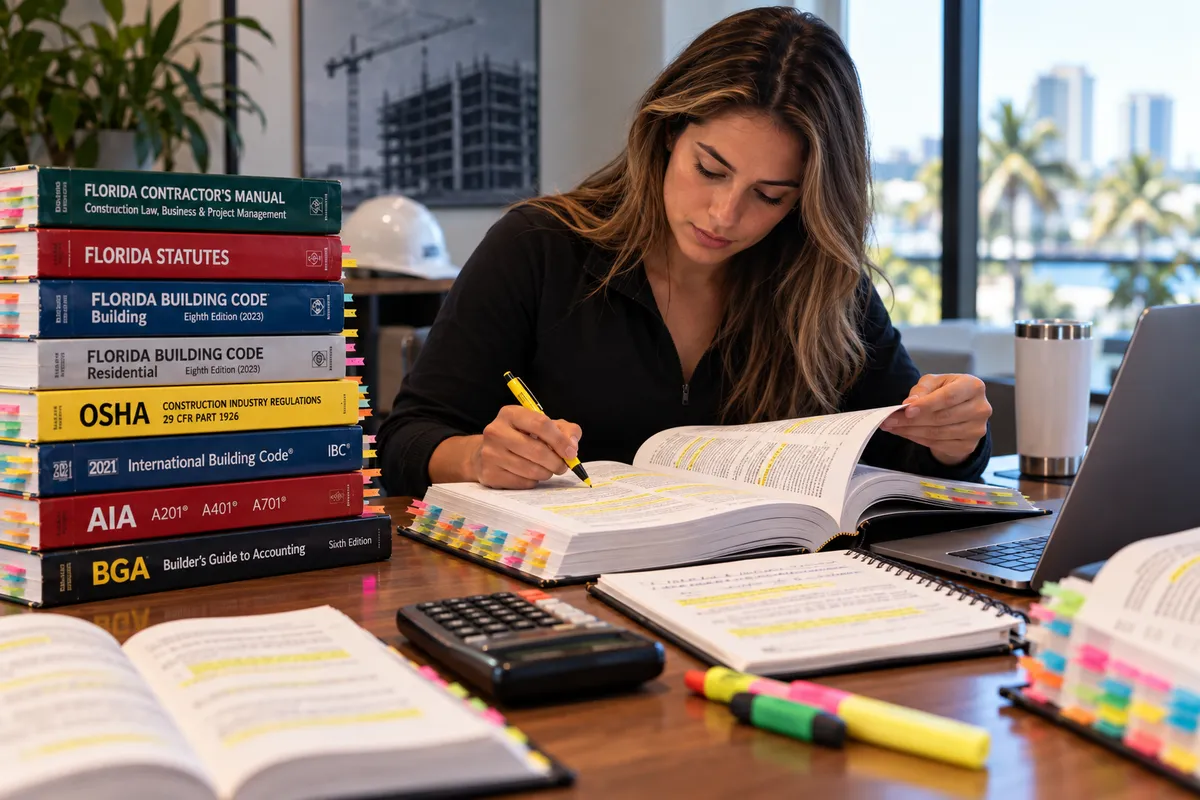
I can't stress this enough. Your reference books are probably your most important tools during the examination, and you need to prepare them yourself. When I say build your books, I'm talking about going through them chapter by chapter, highlighting important information, installing permanent tabs, and learning where everything is located. A lot of students think the fastest way to prepare is to purchase books that are already highlighted and tabbed. I actually recommend the opposite. When someone else prepares your books, you're skipping one of the most valuable parts of studying.
Think about it. When you personally go through a chapter, locate important information, highlight it, and place your tabs, you're becoming familiar with that book. You're learning how the chapters are organized, what information each section contains, and where to find it again. By the time you finish preparing your books, you've already spent hours navigating the exact materials you'll be using during the examination.
Now, you shouldn't just open a 1,000-page reference book and randomly start highlighting things. You need a structured process that shows you what to focus on. That's why exam preparation courses like Florida Exam Prep exist. In our courses, we go through the reference books one at a time, chapter by chapter. Students follow video lessons that show them what to review, what to highlight, and how to organize their books with tabs. After completing each book, they take a full-book practice exam and work toward scoring at least 80% before moving on to the next.
The course gives you the structure, but you're the one doing the work and building your books. That's where a big part of the learning happens. eBy the time you get to the examination, those books shouldn't feel unfamiliar. You've already spent weeks working through them yourself.
2. Identify the Correct Book Before You Start Searching
The first thing I do when reading a question is figure out which reference book most likely contains the answer. This might sound obvious, but you'd be surprised how many people waste time searching through the wrong books.
For example, if I see a question about excavation safety or fall protection, my first thought is OSHA 29 CFR 1926. If I get a Business and Finance question about accounting, I'm thinking about the Builder's Guide to Accounting. If I see a question about Florida contractor licensing regulations, I'm thinking about the Florida Contractor's Manual and the applicable Florida statutes.
Before you even open a book, you should already have an idea of where to start. If you have 10 or 15 reference books sitting in front of you and you're constantly guessing which one to open, you're going to waste valuable time. This is another reason why preparing your books yourself is so important. You've already worked through each reference individually, so you're familiar with which topics are covered in which books.
3. Learn How to Use the Index and Table of Contents
If I had to choose one skill that every student should practice before their exam, it would be learning how to use the index properly. The index is one of the fastest ways to locate specific information in a reference book, especially when you're dealing with hundreds or thousands of pages. But you need to know how to search for the right words. Don't search for the entire question. Identify the most important keywords.
For example, if a question asks about excavation protective systems, I might look for words like excavation, trench, shielding, or protective systems. If the exact wording doesn't appear in the index, I'll try a related term.
You also need to understand when to use the table of contents. If I'm looking for a broad topic, such as concrete construction, estimating, or construction contracts, I might use the table of contents to go directly to the appropriate chapter. Here's how I think about it: the table of contents helps you locate the general subject, while the index helps you find specific information. And when you've already highlighted and tabbed your books, that process becomes even faster. You can identify the chapter, open it using your tabs, and scan the highlighted material instead of reading every paragraph.
4. Don't Highlight Everything
One mistake I see students make is highlighting way too much information. If you're highlighting almost every paragraph on a page, what's the point? When you open that page during the exam, nothing stands out. Your highlighting should help you quickly identify important definitions, requirements, formulas, and other information that could be useful during the examination.
The same goes for tabs. They're supposed to make navigating your books easier, not turn your reference materials into a confusing mess. That's why I recommend following an organized highlighting and tabbing process rather than guessing what might be important. When you're following a structured course, you can prepare your books systematically while learning the material at the same time.
Just remember that your books and tabs need to comply with the testing center's current rules. Make sure you're using approved materials and permitted permanent tabs before walking into the examination.
5. Know When to Stop Searching and Move On
Sometimes you're going to get a question where you know the answer is somewhere in your books, but you just can't find it.You check the index, flip through a chapter, look at another section, and before you know it, you've spent 10 minutes searching for one answer.That's a problem.For example, the Business and Finance exam gives you 6 hours and 30 minutes to answer 125 questions, including five unscored pilot questions. That's just over three minutes per question.
When I took my exams, my strategy was to collect as many points as possible. If I knew an answer, I answered it. If I could quickly locate it in my books, I looked it up. But if something was taking too long, I marked it and moved on. I wasn't going to spend 15 minutes on one difficult question when I could potentially answer five easier questions during that same time. Remember, a difficult question is worth the same number of points as an easy question. You don't get extra credit for spending more time on it.
6. Practice Finding Answers, Not Memorizing Them
Once your books are prepared, the next step is practicing how to use them. This is why I recommend taking practice exams for each individual book before jumping into full-length exam simulators. When you're answering questions from one reference book, you're learning how to navigate that specific book. You're figuring out where different topics are located, how the index works, and which chapters contain the information you're looking for.
Once you've mastered each book individually, you can start taking full-length simulators that require you to switch between different references, just like the actual examination. One thing I always tell students is that you shouldn't just memorize practice exam answers. If you take the same exam five times and eventually score 100% because you remember all the questions, that doesn't necessarily mean you're prepared.
I would rather see someone score 80% while correctly finding the answers in their books than score 100% because they've memorized the answer choices. The real examination will have questions you've never seen before. You need to develop the ability to find answers even when you don't recognize the question.
My Final Advice
If I had to take my Florida contractor exams again tomorrow, I would use the same approach. I would make sure I had personally prepared my reference books, practiced navigating them, and become familiar with their chapters and indexes. Then, during the examination, I would read each question, identify the correct book, use the index or table of contents, and locate the information as efficiently as possible.
If I couldn't find something quickly, I would mark the question and move on. The biggest thing I want you to understand is that preparing your books is part of preparing yourself for the exam.
Don't skip that process by purchasing books someone else has already highlighted and tabbed. Take the time to build your own books. Use a structured course to guide you through the material, but make sure you're the one actually doing the highlighting, tabbing, and practice questions.
That's exactly how we've structured our courses at Florida Exam Prep. We show you what to study, but you're the one working through each chapter, preparing your books, and learning how to find the answers. By the time you finish, you're not just walking into the testing center with a stack of books. You're walking in with books you've personally studied, organized, and practiced using. And that can make a tremendous difference.
Good luck on your exam!
Cruz Vinci Greico
Head Instructor, Florida Exam Prep